Sunday, January 9, 2011

Volcan Puracé

Puracé Volcano is roughly 15,000 feet above sea level and lies just outside of Coconuco, Cuaca, Colombia. The Volcano's last explosion (according to the infallible internet) was in 1977. The park ranger at the base told me it was in 1958 and that several geology students hiking to the summit were killed. Not sure who's right. A swiss traveler and I made the round trip trek from the base to the summit crater in about 5 hours. We got up at 3:30 am that morning to catch a crowded 4:30 am bus which got us to the base around 8:00am. After having some hot chocolate and cheese, we started up and were back down in time to have lunch with the park ranger. We saw some scary thunderclouds in the distance so we kept a brisk pace. Despite the looming rain, however, we caught some great sunshine and some pretty breathtaking views of the region.Standing on the summit feels like being on the moon.


The squiggly trail up to the top. At more than one point my Swiss pal and I felt like Frodo and Samwise scrambling up Mt. Doom

The view from the top, roughly 4,600 meters above sea level.

The crater. It's deep.
The peak used to be snow capped but has since lost all snow cover. An unfortunate sign of global climate change...the silver lining being that the hike is a lot easier without snow.

Tierradentro

I spent about two days in this area and was fortunate enough to explore the tombs with some Colombian anthropology students I met on the way up.
Tierradentro, a national park located in the Southwestern Colombian department of Cauca, is home to some of South America's most impressive and mysterious archeological sites. In the hills surrounding the small town of San Andres de Pisimbala lies an expansive collection of subterranean tombs pertaining to an indigenous group which preceded the current Paez indigenous community of the region. Little is known about the people who built these tombs, who archeologists think flourished in the region beginning in 600 BCE.


Under each of these green pavilions lies the entrance to a group of burial chambers. This grouping here is called Altos de Segovia, and is one of 5 grave complexes discovered around San Andres.

Visitors to the park descend through these trap doors and are able to get a first hand look at the burial chambers.

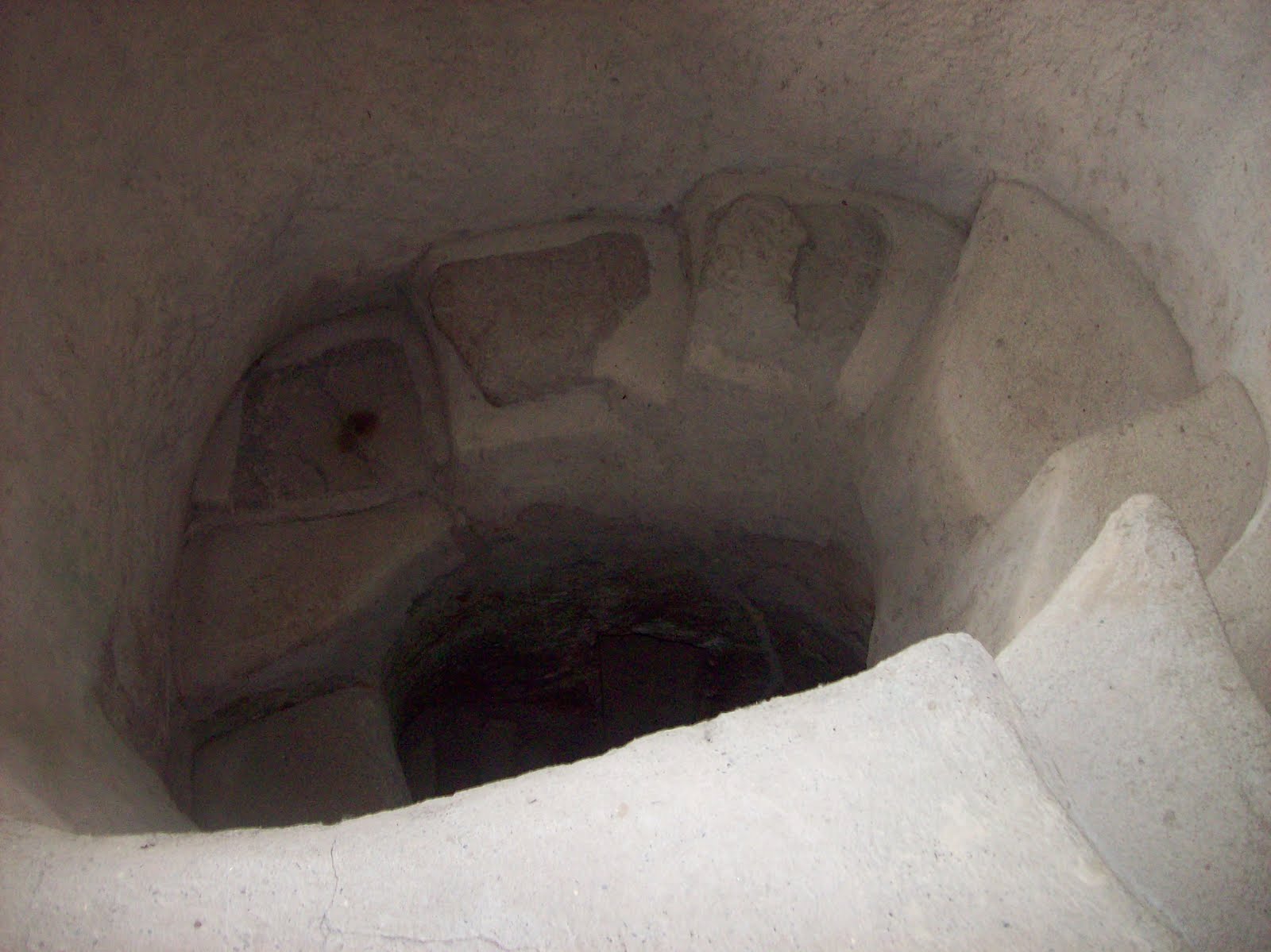
But first you have to survive the descent of about twenty feet. Many of the tombs had spiral staircases, although some had more direct, vertical, stairs.
The tomb entrance consists of a small door, which would have been covered by a large, flat rock.

The burial chambers in Tierradentro vary depending on the social class of those buried inside of them. Some of the common chambers held up to 60 bodies, while more elitist tombs may have only had 7. This tomb bears no decoration, suggesting it might pertained to people of modest means. The more elaborately decorated tombs--of which you cannot take flash pictures :( -- are painted in red and black thatch work which is meant to imitate the actual interior of this indigenous group's dwellings. These tombs essentially reflected a new 'home' for the deceased.

An uncovered grave. I'm not really sure how the roof disappeared from the tomb. Either way, it shows the size the of burial chambers. The park guide estimated that these tombs took 8 years to build, although I don't think there is any real consensus on how long the process actually took. Regardless, constructing tombs such as these required significant time and energy, which demonstrates the great stress this group placed on the afterlife.


Tuesday, November 23, 2010

Kicking it with the kids

As I mentioned in an earlier post, I've had the opportunity to do some work with Fundacion Romelio, (romelio.net), a non-profit educational center for pre-school aged children in northern Bucaramanga. The northern neighborhoods have the fame of being the poorest and most dangerous sections of Bucarmanga . Many rural Colombians displaced by the ongoing domestic conflict settle in this part of the city.

At the center, I've begun doing weekly English classes with the kids, who range from 2 to 5 years old. When teaching English to such young people, the most important thing isn't necessarily that they learn lots of new vocabulary. Rather, what matters is that they have exposure to the concept of another language and that they start to become familiar with a few basic words.

Classes so far have consisted of sing-alongs accompanied with drawings of the subjects in the songs. So far we've covered '5 Little Ducks', 'Baby Bumblebee' and 'Old MacDonald'. I've tried to keep the animal theme going because it offers something these young students can relate to. They really like the word 'bumblebee'...actually, they particularly enjoy yelling it as loud as they can. It must sound better that way. I have a disc of children's songs I got off of iTunes which I use in the classes. The copy of 'Old MacDonald' for some reason contains a verse about Old MacDonald having a Brontosaraus. I was quite surprised at how many students could actually pronounce this word (and how many can't pronounce 'duck'). It takes an incredible amount of repetition before the students start to remember the names of the animals, but for some reason everyone seems to remember the word 'chicken' on the first try.

Other than that, I've recently started doing private lessons with a 10 year old Colombian boy. His English is really impressive, so he's been retelling me all about the Harry Potter series. We just got done talking about the Sorting Hat. Everyone else in the world has read Harry Potter, except me. Now it looks like all I have to do is sit back, listen, (watch for grammar mistakes), and pretty soon I'll be able to talk to everyone else back home about Quittage and Voldemort.

Also, here are some statistics: Times I almost got hit by a bus yesterday:3; times I almost got hit by a taxi:2; times I almost got hit by a motorcycle:3. Times I actually got hit by a bus/taxi/motorcycle: 0. I think there's a cliche about 'close' only counting in horseshoes and grenades.

Tuesday, November 2, 2010

A short story about a short taxi ride

This afternoon I hopped in a cab to go home for lunch. I've repeated my home address so many times that I can almost say it without an accent. But today I didn't fool the driver and a few minutes into the ride he asked me where I was from. I told him I lived in the United States. He then switched into English, telling me that he had worked as a cab driver for over 14 years in New York City. During that time, he practiced his English with not only New Yorkers, but people from all over the world. It was interesting, he said, because it gave him the chance to learn many different forms of English. "I practiced my English with people from China, Japan, Africa, and the Middle East" he explained, looking back at me in his rearview mirror. "And you know who was the most difficult to understand?"

"Who?" I wondered out loud.

"Texans", he said.

Monday, October 18, 2010

I saw this coming

Before arriving in Colombia, I decided I would start a blog so that I could keep my friends and family updated on my South American adventures. I told myself I would keep my blog diligently and that I would post all kinds of amazing insights and pictures. But I knew this was just a pipe-dream and that my blog-discipline would soon wane.

And waned it has. So, after not writing for just over a month, I'm returning to the blog-o-sphere...we'll see if thoughts of interest to you, the reader, follow.

Here's the skinny on my English teaching: Not much to report. I spend most of my time 'observing' professors and rarely am I given time to do activities with the students. I guess this is supposed to be a 'prep' semester for me so that next semester I can (theoretically) take over my own class. But I've sat in classrooms for at least 90% of my life and 'observed' professors. To be sure, I've learned a few things from this most recent observation period (like don't sweat it when most students show up 15 minutes late). But the only way I'll be prepared to be a teacher is to actually teach. To make mistakes and learn from my mistakes.

Speaking of mistakes: I've been teaching weekly technical English classes to nurses at my university's medical school. It's not that this was a mistake...it's that for some reason only 3 of the 10 nurses have been coming to class as of late. I don't know if it's something I did. Could be due to the fact that without knowing it I designed an entire class period using activities from a book all the nurses had finished last semester. But I have a feeling their absence is a product of their recognizing the following: 1) They know I'm not in charge of their grade, and 2) I'm more or less their own age and therefore have difficulty being an authority figure, and 3) Having a demanding medical course load AND working at a medical clinic in the nights maybe doesn't leave much energy for going to yet another English class. Who knows. I will admit one big mistake on my part. I think I underestimated my students' enthusiasm. Everyone hates studying grammar, but the few times these nurses have had the chance to actually have fun with their English, they've been incredibly energetic and engaged. For example, one week we did a role-play in which a team of nurses had to explain to a student and her family that she had terminal cancer and only 6 months to live. They really liked this activity and especially enjoyed torturing their classmate with details about her impending death. 'See you at the funeral' was the last phrase uttered before time was up and class was dismissed.

In other news: I've recently been involved with an incredible organization in Bucaramanga called Fundación Romelio. Fundación Romelio advocates for the citizens of Northern Bucaramanga, one of the cities poorest and most disenfranchised neighborhoods. Specifically, Fundación Romelio operates a 9 classroom educational complex designed specifically for children ages 0-5. The idea is that this phase of life is extremely crucial for human development and that all children (especially those living in trying circumstances) deserve and need a nurturing environment in these early years. I visited the organization last Friday, and after sharing a snack of popcorn and crackers with some of the kids, we spent the next hour dancing. These four year old Colombian girls are the only ones who haven't made fun of my complete inability to dance. (It's not my fault I'm tall, white and Irish and therefore bereft of rhythm and grace). At Fundación Romelio being 6'1'' makes me comparatively a two-story building to these little people. It was nice being the center of attention of so many smiling faces who just wanted to share some time dancing and running around. And while all these kids seem very happy for the few hours a day they get to spend at Fundación Romelio, most will return to wooden shacks with dirt floors and insufficient protection from the rain. Unlike many kids, most of the children at Fundación Romelio (half of whom live in families which have been displaced by Colombia's internal conflict) can't wait to get to school in the morning and are reluctant to leave in the afternoon. Should any of you back home be interested in learning more about or supporting Fundación Romelio's incredible efforts, here is their web-page (in Spanish :S...but take a look and I'll answer any questions you may have!): http://www.romelio.net/index.html
So those are the Bucaramanga happenings for now. More to follow. Unfortunately a bunch of ants have just dug a hole leading to our kitchen counter...so I should probably go take care of that.


Friday, September 17, 2010

Life Stories

In my 6 or so weeks here in Colombia I've had the opportunity to hear some pretty incredible life stories. Hearing personal narrative is a fascinating way to get to know a country, so I've included here some short renderings of Colombian lived experience. I've tried to keep the stories as brief as possible. They're snapshots and nothing more. I've also changed the names of the those involved. Here's a look:

Doctor Silva: Dr. Silva graduated from medical school in the 1970's. He and his wife, another doctor who he met while in medical school, left for the Colombian department of Choco to do a year of medical work in the jungle. Rural access to health care in Colombia is extremely difficult, and thus all new doctors are required to do a year of medical service in a rural region of Colombia. While performing her service, Dr. Silva's wife had an allergic reaction to an anti-biotic and due to the remote location, wasn't able to reach adequate medical facilities in time. She passed away less than one year after having become a doctor.

Ellen Jones: Twelve years ago, Ellen fell in love with a Colombian man who was studying in England. Ellen decided to leave native England and follow her love back to Colombia. She's been working as an English teacher in Colombia ever since, and she and her husband have two children ages 6 and 3. Ellen's primary occupation at the moment is trying to save enough money to buy plane tickets for her family (and a visa for her husband) so that they can return to England to live. For her it's imperative that they leave Colombia before her son turns 16 and is obligated to serve in the armed services. In Colombia two years of military service is required for all young men, or at least the ones who can't afford to attend a university. While Ellen loves Colombia, her fear of losing her son in armed conflict is compelling her to return back to the country she hasn't seen in over a decade.

Maria E. : Maria met her first love when she was 15, and married him at 18. Her husband worked as a taxi-driver. He was murdered at age 23 by a drunk passenger who refused to pay the cab-fare. A few years later Maria remarried a professional soldier. This man was one month away from completing his military service, but was killed while fighting leftist guerrillas in Santander. He and Maria had been married for just a year. Maria's next husband left her when she was five months pregnant. "Love isn't for me," Maria told me after having related the story of her three husbands.

Alejandro: Alejandrom ,20, and his family left their hometown of Barranca ten years ago to come live in Bucaramanga. Alejandro's father's physical appearance so closely resembled that of an infamous leader of the FARC (Colombia's most powerful leftist-rebel group) that he received constant death threats. As such, he was forced to relocate his family and start a new life.

Adrianna S.: 15 years ago Adriana, a native of Bogotá, did some brief consulting work in New York City. She worked in the World Trade Center and there befriended several Latin American employees of the same company. On the 9th anniversary of 9/11, Adrianna and I recounted our memories of that day. She said she watched in horror, fearing for her friends who worked in the building. To this day, she doesn't know if they survived, although she suspects they didn't.

I know these are heavy stories and they highlight the some of the more difficult facets of Colombian life. Nonetheless, they are stories which have made an impression on me, and I know they will always be in my memories of Colombia.


Wednesday, September 1, 2010

Nurses, Colors, and Landslides

One of my newest responsibilities as an English teaching-assistant is to travel once a week to ‘El Bosque’, the medical school campus associated with La Universidad Autónoma de Bucaramanga (UNAB). While there I run a conversation club designed specifically for nursing students. 7 to 8 semesters of English are required for all UNAB students. However, students in the nursing program have an even heavier course load, as English is becoming more and more of a requirement in the nursing profession. I have to hand it to these girls. (All ten of my students are young women. Of the 80 or so students in the nursing program, only ten are men). Classes for these aspiring nurses typically start at 7 a.m. and most of them stay on campus until at least 7 p.m. After that it’s back home to study. After class ended at 6pm, one of the girls was catching a bus which would take her an hour across town so she could go to yet another English class!

I showed up late for this nursing class for this week (for the second time…out of two times) because for the second time I got on the wrong bus. I’m supposed to get on the bus that says ‘Carñaveral’…but with ‘Carñaveral’ written in yellow letters and not blue letters. I’m starting to see the holes in my liberal arts education. Here’s to hoping next week my kindergarten life skills actually work and I can tell the difference between two primary colors. Luckily all the nurses showed up late to class as well. I’m getting the hang of this not being punctual thing and I think I kind of like it.

At the end of the week I will be concluding my one month stay with my Colombian host family before I move into an apartment with other foreign students. This family has treated me exceptionally well, and living in such a nice neighborhood has made my transition into Colombiamuch smoother. I currently live in a neighborhood officially designated ‘Estratus 6.’ Colombiahas system whereby neighborhoods are given an official designation of 1-6, with 1 being the poorest and 6 being the wealthiest. I will be moving to an ‘Estratus 4’ (I think?) neighborhood soon. Not too much will be different…just a bit noisier, I won’t have a doorman, and my front door has 3 deadlocks.

I’m not going to pretend I have any real sociological knowledge of classism and wealth stratification here in Colombia, but the view from my host family’s front window provides an interesting glimpse. Looking east, one sees a mountain ridge covered in tropical vegetation. At the south end one sees this:

I think the technical tern is 'Really Nice House'

Panning one’s view to the north on the same ridge only about 50 meters, one sees this:

This structure is commonly called an 'invasion', at least by wealthy Colombians. It's a settlement constructed by poor residents with no official claim to the land.

And just about another 50 meters north, this appears:

Landslides like this are common in the mountains around Bucaramanga. Unfortunately, many of the precariously constructed 'invasions' fall victim to these landslides every year.

This ridge spans an entire social strata. I was struck by the close vicinity of the extremely affluent and extremely poor. It remains to be seen if this 'invasion' will one day be claimed by a landslide. The other day I walked less than 20 seconds into the forest behind my host family’s apartment (maybe not the best thing to do by myself?) and I stumbled upon a cow tied to a tree. We looked at each other for a moment and I was about to start a conversation (it’s sometimes easier to practice Spanish with non-humans) when I noticed a tin shack hidden in the trees a few meters back. There was a man in a torn red t-shirt in front of his dwelling, staring off into the distance. He didn’t see me, and I slowly retreated. With only a few small steps I crossed from the world of ‘Estratus 6’ to the world of ‘Estratus 0.’ From the world of the people who write the map to the world of the people who aren’t even on the map.